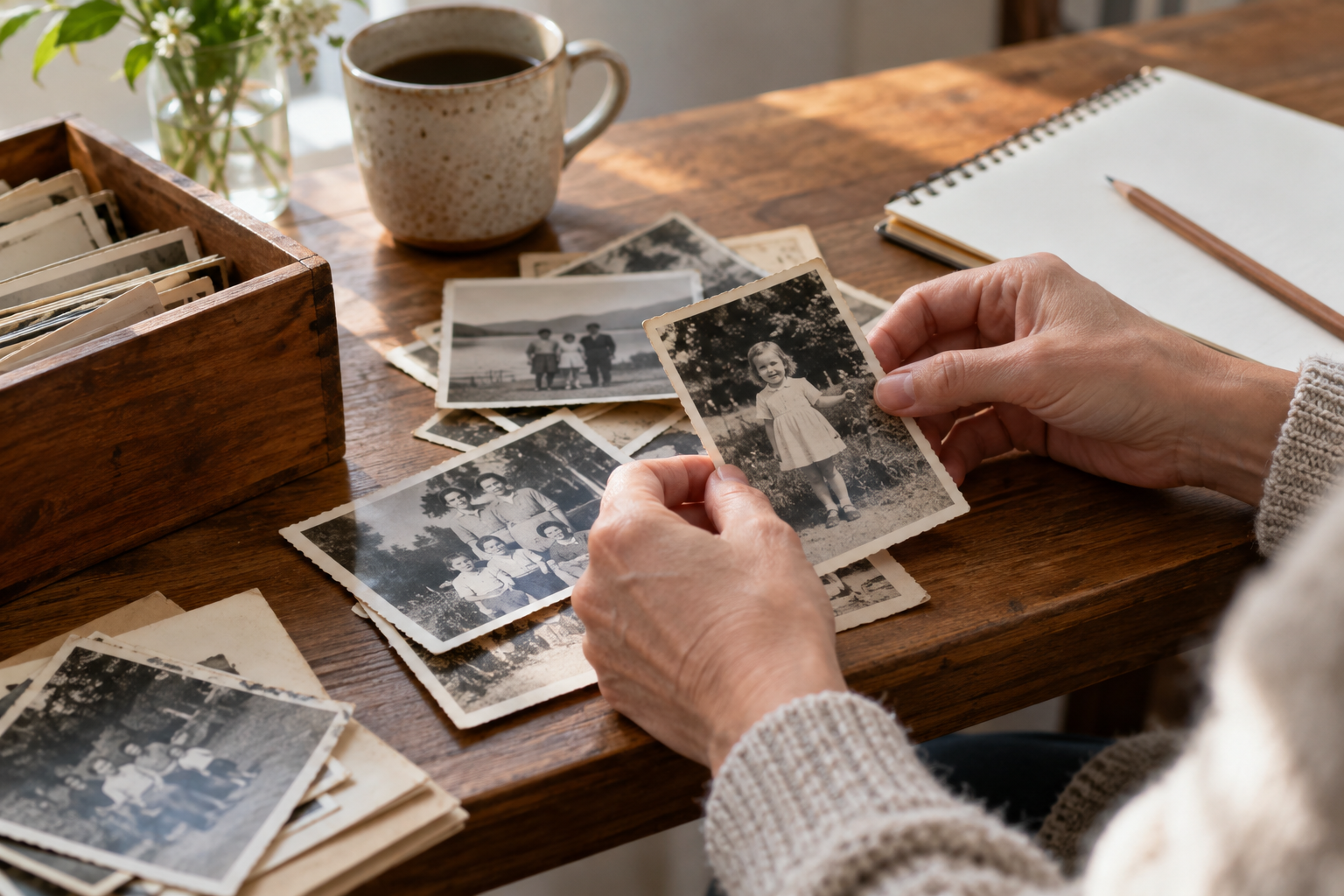
A box of family photographs may contain familiar faces alongside people nobody can identify. The images remain meaningful, but their context becomes harder to recover when names, places, and dates are missing. Organizing a small selection with careful labels is a manageable way to preserve information without pretending to solve every uncertainty in the collection.
Start with information you can actually establish
Choose a few photographs rather than opening every album at once. Work on a clean surface and keep the original arrangement where it provides clues. Ask relatives whether the photographs belonged together or were collected from several households. The history of the collection can be useful even when an individual image remains unexplained.
Write down what is visible separately from what someone remembers. A photograph may show three people outside a building; a relative may recall that it was taken after a celebration. Both observations can be recorded, but they have different sources. Note the name of the person providing the memory and the date you spoke with them.
Use honest wording for uncertainty. Approximate dates, possible locations, and unidentified people should remain marked as such. Avoid guessing an exact year from clothing alone. If another photograph or document supports an identification, record the connection so a future reader can understand how you reached it.
Connect images with useful and respectful records
Create a simple inventory with an identifier for each image. Record known names, the likely place, the date or estimated period, the source of the information, and any restrictions on sharing. An identifier can link a digital copy to its description without requiring a long filename containing private family details.
Handle originals carefully and avoid writing across the image surface. When a photograph is damaged or unusually fragile, seek suitable preservation advice before attempting repairs. A digital copy can make viewing easier, but it does not remove the need to keep the original safely. Check that copies are readable and retain a separate backup.
Ask relatives before sharing photographs publicly, especially when images show children, private events, or information people would prefer to keep within the family. Ownership of a physical photograph and permission to publish a person’s image are separate considerations. A private album may be the right destination for some material.
Invite others to add corrections without overwriting earlier notes silently. Recording a changed identification can preserve the reasoning behind it. The aim is a collection that future relatives can understand and improve, with clear information about what is known, what is remembered, and what still needs investigation.