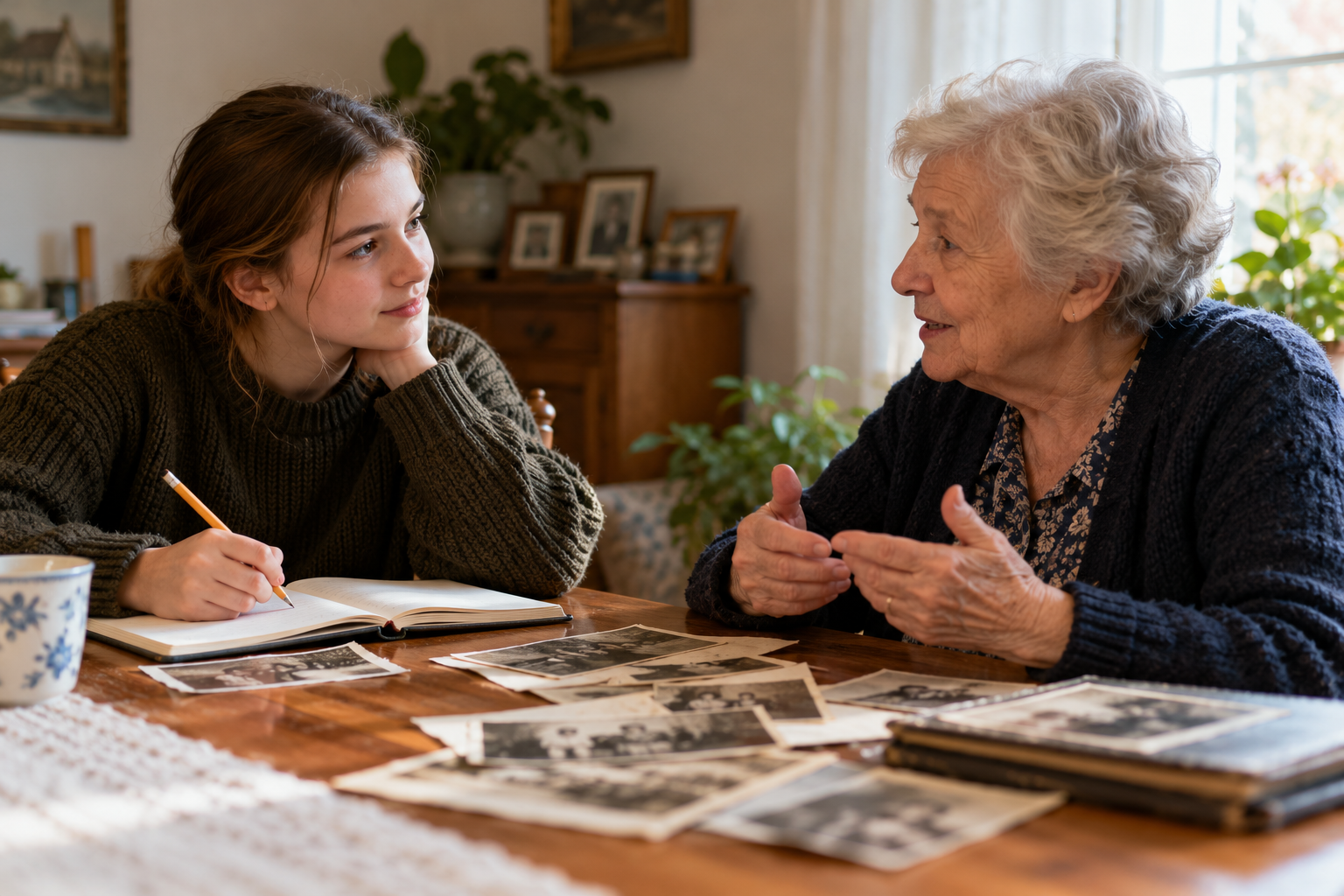
An interview with an older relative can turn family history into a shared learning project. Young people practice listening, asking questions, and organizing information while discovering experiences beyond their own. The conversation works best when it feels like an invitation to remember, with room to pause or change direction, rather than an assignment that must produce a dramatic story.
Prepare questions that invite detail
Agree on a manageable topic before the interview. A school day, a first job, a family celebration, or a familiar street may be easier to discuss than an entire lifetime. Ask the relative what they would enjoy talking about and how long they would like the conversation to last.
Help the young interviewer prepare a few open questions. What did the room look like? Who was usually there? What happened on an ordinary afternoon? Concrete prompts can encourage detail without suggesting a particular answer. Avoid beginning with questions that assume hardship, migration, or conflict. Those subjects should be introduced only when the speaker is comfortable discussing them.
Explain recording choices in advance. A notebook may be enough, or the relative may agree to an audio recording. Ask separately about keeping the recording, sharing it with family, and using it in a school project. Permission for a conversation does not automatically include permission to publish it online.
Turn listening into careful work
During the interview, leave time for answers and resist correcting every small detail. Follow up gently when something is unclear. If a date is uncertain, record that uncertainty instead of inventing an exact year. The interviewer can return to the question later or compare the memory with a document, if the relative agrees.
Encourage breaks and accept topics the speaker prefers to avoid. A useful interview does not depend on collecting painful memories. Ordinary details about meals, games, work, or neighborhood routines can be valuable in their own right. Young people should know that a respectful conversation includes the right not to answer.
Afterward, organize notes into a short account with a beginning, a few connected details, and a closing reflection. Separate direct quotations from summaries. Label photographs with the information available and leave unknown names or dates clearly marked. Do not describe a memory as a verified fact simply because it was told confidently.
Let the relative review the finished work before it is shared. Invite corrections and remove material they do not want included. Thank them for their time and explain what the young person learned. The strongest outcome is both a useful record and a conversation that makes another conversation possible.