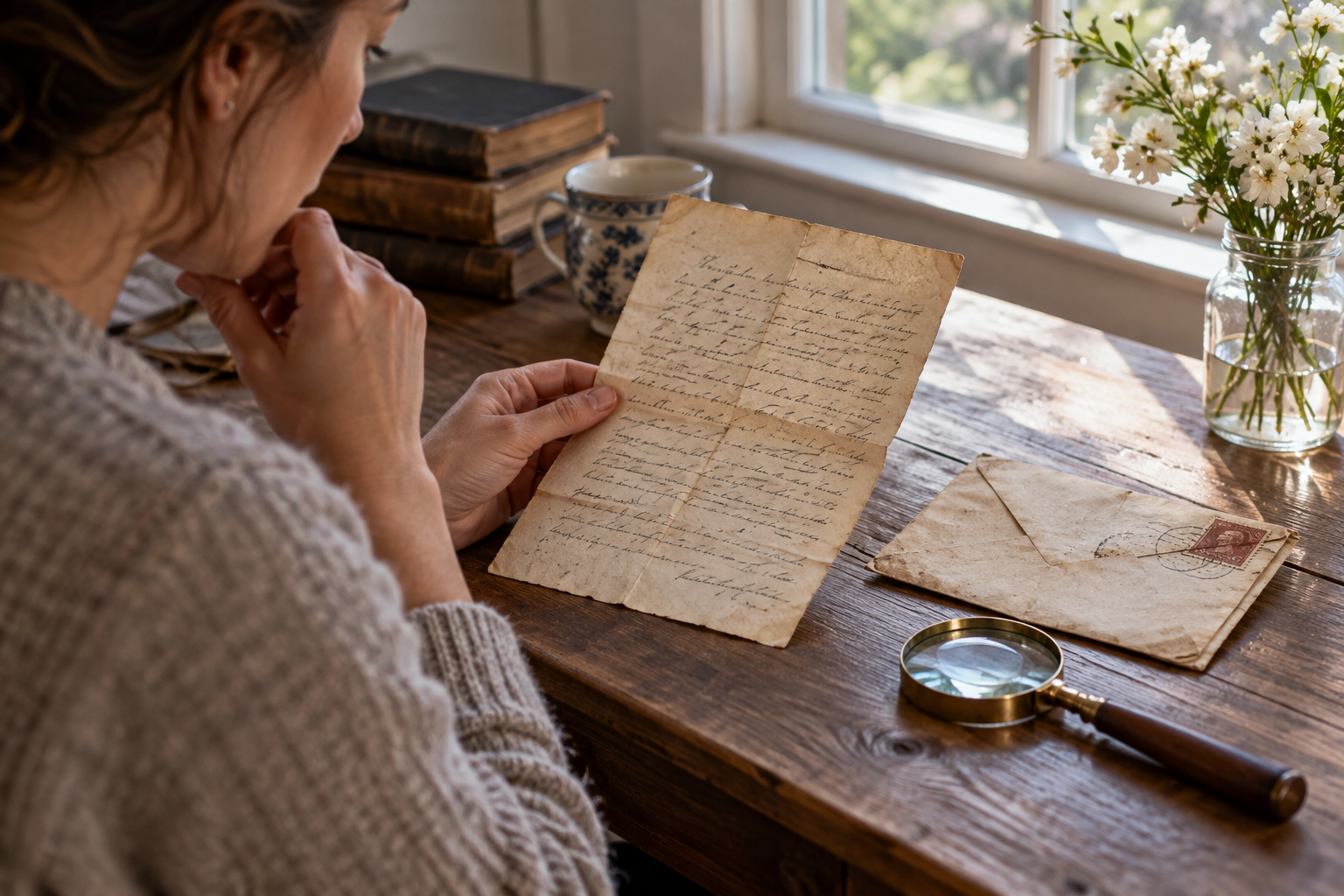
An old family letter offers a glimpse into a particular moment rather than a complete explanation of the past. Its writer may assume that the recipient already knows names, events, and private circumstances. Reading it carefully means paying attention to those gaps as well as to the words on the page. A thoughtful approach can preserve both the document and its uncertainty.
Establish the basic details first
Begin with the information the letter provides directly. Record the date if it is visible, the writer and recipient if they are identified, and any place mentioned. Note whether you are working with an original, a photocopy, or a digital image. Keep the envelope with the letter when possible because it may supply additional context.
Make a transcription that follows the original wording. Mark unclear words rather than replacing them with guesses. If handwriting is difficult to read, compare repeated letters and ask another reader for help. A clean transcription can sit alongside the image so other relatives can check your interpretation.
Treat a translation as a separate version. Idioms, affectionate names, and everyday expressions may not have an exact equivalent. Explain important choices and preserve the original text. If a phrase remains uncertain, say so. Smooth English should not conceal that several interpretations might be possible.
Ask what the writer could reasonably know
Consider the purpose of the message. Was it a practical request, a greeting, a report, or an attempt to reassure someone? A writer might omit problems, exaggerate success, or use a familiar joke. Avoid assuming that every sentence gives a neutral account of events simply because the document is old.
Identify references using other material when available. A photograph, address book, or second letter may clarify who a nickname describes. Keep these connections documented and distinguish them from conclusions based only on inference. One letter should not be used to make sweeping claims about an entire community or historical period.
Respect privacy when deciding what to share. A family document may contain personal concerns about health, relationships, finances, or people who are still living. Discuss publication with those affected where appropriate. Removing names or keeping the document in a private collection may be more suitable than posting the complete image.
Finish with a short contextual note explaining the source, transcription, translation, and unresolved questions. Let other family members contribute without forcing agreement on every detail. Careful reading can bring a voice from the past closer while preserving the distinction between what the letter says and what later readers think it means.